



Best Survival Equipment for Hikers: 2026 Gear List
Table of Contents
- What Survival Equipment Hikers Actually Need
- The Hiking Survival Gear List: What to Carry and Why
- Best Survival Backpack Kit: Choosing a Pack and Building the Base
- Hiking Emergency Kit Essentials: First Aid, Fire and Shelter
- Water Filter for Wild Camping: Purification Without the Weight
- Navigation and Lighting: The Survival Equipment That Gets You Back
- How to Practice With Your Survival Equipment
- Conclusion
- Frequently Asked Questions
Last Updated: October 21, 2026
What Survival Equipment Hikers Actually Need
The best survival equipment for hikers is the small set of items that keeps you alive and findable when a walk turns into an unplanned night out. It is not a military-style grab bag.
Below, we break down what to carry, what it weighs, and how to practise with it before you need it. The list is short on purpose.
The Hiking Survival Gear List: What to Carry and Why
A working hiking survival gear list fits into six categories: medical, fire, shelter, water, navigation and light. Each one solves a different failure. Lose any single category and your options shrink fast.
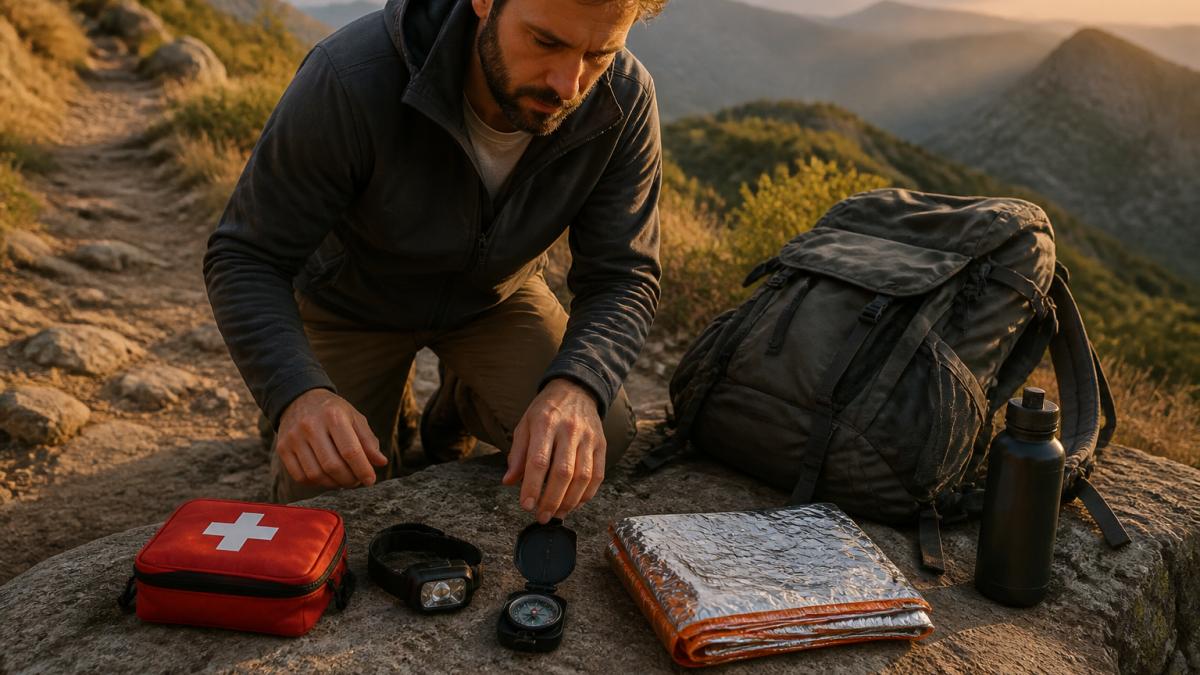
The non-negotiable core (every hike, including a two-hour walk)
These are the items that turn an unplanned night out into an inconvenience rather than an emergency. They weigh very little and there is no good reason to leave any of them behind.
- First aid: a compact kit with trauma dressings, blister care and pain relief
- Shelter and warmth: an emergency sleeping bag or bivvy plus a spare insulating layer
- Fire: a flint starter and dry tinder kept in a sealed bag
- Water: at least one litre carried, plus a filter straw if you plan to refill
- Navigation: a paper map of the area and a compass, even if you use a phone
- Light: a head torch with fresh or charged cells
A realistic core weight is around 700 g to 900 g before water: a 490 g first-aid kit, a 62 g fire starter, an emergency bag that weighs almost nothing, a pocket compass at roughly 70 g and a head torch at around 326 g.

What to add for a full day out
Once you are out for six hours or more, the failure modes change. You are more likely to be benighted, more likely to run out of water, and more likely to need to repair something.
- Extra water capacity or a reliable refill point marked on the map
- A second purification method such as tablets, in case the filter clogs or freezes
- A small repair kit: tape, a spare buckle, cord and a multi-tool
- Emergency calories: a few hundred grams of high-energy food beyond your lunch
- A power bank for the phone you are using as a backup camera and map
What to add for an overnight or a remote route
Remote ground raises the consequences of every failure, so the kit becomes about redundancy and signalling rather than comfort.
- A second light and spare batteries, because a single head torch is a single point of failure
- A personal locator beacon or satellite messenger where phone signal is unreliable
- A group shelter in addition to individual bags if you are walking in a group
- A paper copy of your route and a written trip plan left with someone at home
- More food and fuel than you think you need, plus a stove you have tested
The mistake we see most often is buying a huge kit and never carrying it. A smaller kit you take every time beats a perfect kit that stays in the cupboard. Build the core first, then add the day and remote layers as the trip demands.
Best Survival Backpack Kit: Choosing a Pack and Building the Base
The best survival backpack kit starts with the pack itself. You need something that holds 36 to 55 litres for a full day or an overnight, carries the weight on your hips, and does not fall apart when it is scraped against rock.
Our 36-55L Hiking Backpack (£46.95) is built from Oxford fabric with a medium-hard construction that keeps its shape when half-loaded.
Build the base in this order:
- Shelter and warmth in the lid pocket so it is the first thing out
- First aid at the top for quick access
- Fire and light in a side pocket you can reach without unpacking
- Water and filter against your back
- Spare layers and socks at the bottom
Hiking Emergency Kit Essentials: First Aid, Fire and Shelter
Hiking emergency kit essentials come down to three jobs: stop bleeding, start a fire, stay warm. Everything else is secondary.

For fire, the Multifunctional Flint Fire Starter (£10.95) weighs just 62 g and does more than spark.
For shelter, the Emergency Sleeping Bag (£8.50) is the lightest insurance policy you will carry. The bright orange bivvy reflects body heat back in and keeps rain and wind off.
Water Filter for Wild Camping: Purification Without the Weight
A water filter for wild camping lets you refill from streams and tarns instead of carrying every litre.
The Portable Drinking Water Filter Straw (£18.95) is 18 cm of plastic with a built-in filter, weighing roughly 105 to 300 g depending on the variant.
What most guides miss is the backup.
For any trip where you rely on wild water, check the current guidance from the Environment Agency on water quality before you set out.
Multifunctional Outdoor Survival First Aid SOS Kit →
Navigation and Lighting: The Survival Equipment That Gets You Back
Survival equipment is only half the job. Navigation and light are what get you back to the car when the cloud drops and the light goes. The gear matters less than the habit of using it before you are lost.
Paper beats a phone battery. Carry a waterproof map of your route and a Metal Flip-Lid Pocket Compass (£10.95). The flip pocket-watch design and metal case make it quick to use with cold hands, and at around 70 g it disappears into a pocket.
How to actually use a map and compass
Most hikers carry a compass and have never taken a bearing with it. The skill is simple and worth practising once in good conditions.
- Set the map. Lay the compass on the map with its edge along your direction of travel and the direction-of-travel arrow pointing the way you want to go.
- Turn the bezel until the orienting arrow lines up with the map's north lines, then read the number at the direction-of-travel line. That is your bearing.
- Hold the compass flat in front of you and turn your body until the red needle sits inside the orienting arrow. The direction-of-travel arrow now points along your bearing.
- Pick a landmark on that line, walk to it, then repeat. Do not try to walk a bearing with your eyes on the compass.
Add magnetic variation if your map states it, and remember that a phone compass is a backup, not a primary. Batteries fail in the cold, and a cracked screen is useless in the rain.
Lighting that doubles as a signal
For light, the Rechargeable LED Head Torch (£26.95) combines an L2 main LED, two T6 auxiliary LEDs and two COB sources, with a long-press red-and-blue warning mode and an SOS function.
The SOS mode matters: it is how you signal for help after dark.
A Rechargeable LED Camping Lantern (£15.95) at 154 g is the tent-side companion, useful for cooking and sorting kit after sunset, but it is not a substitute for a head torch you can wear while moving.
If you walk in remote ground, read the Mountain Rescue England and Wales safety advice before you go and carry a way to call for help that does not depend on a phone signal.
How to Practice With Your Survival Equipment
Buying gear is the easy part. The difference between a kit that works and a kit that sits in a bag is practice.
Run through these before every season:
- Light the fire starter in wet conditions and get a flame going
- Get inside the emergency bag fully clothed, in the wind
- Take a compass bearing and follow it for 200 metres
- Use the head torch's SOS mode and confirm it is visible
- Check every first-aid item for expiry and replace what is out of date
- Filter water from a safe source and taste the result
The UK's mountain rescue teams are volunteer-run and rely on walkers carrying the right kit and knowing how to use it. Mountain Rescue England and Wales safety advice is worth reading before any trip into remote ground.
Conclusion
The hardest part of survival equipment is not buying it. It is carrying it every time, even on the short walk that was meant to be easy, and knowing how to use it when the weather turns.
At TAKE A HIKE, we stock the kit we would take ourselves: the Multifunctional Outdoor Survival First Aid SOS Kit, the Emergency Sleeping Bag and the 36-55L Hiking Backpack.

Get started with TAKE A HIKE and build a kit you will actually carry.
Frequently Asked Questions
What survival equipment should every hiker carry?
Every hiker should carry a compact first aid kit, a fire starter, an emergency sleeping bag or bivvy, a water filter, a head torch, a compass and a paper map. Add a multi-tool, spare layers and a power bank for longer routes. The TAKE A HIKE Multifunctional Outdoor Survival First Aid SOS Kit at £35.95 covers the first aid and rescue basics in one 490 g pack. The goal is not to carry everything, but to carry the items that buy you time if something goes wrong.
What is the best survival backpack kit for a day hike?
A day hike survival backpack kit should fit a 36-55L pack, which gives room for layers, food, water and emergency gear without excess weight. The TAKE A HIKE 36-55L Hiking Backpack for Mountaineering and Camping (£46.95) is made from Oxford fabric and weighs around 1.12 kg. Inside, pack a first aid kit, fire starter, emergency sleeping bag, water filter and head torch. Keep the heaviest items close to your back and the emergency kit in an outside pocket you can reach without unpacking.
How do you build a lightweight survival kit for hiking?
Start with multi-purpose items and avoid duplicates. A flint fire starter with a built-in whistle and scraper replaces three separate tools, and the TAKE A HIKE Multifunctional Flint Fire Starter weighs just 62 g at £10.95. A filter straw at 105-300 g removes the need to carry litres of water. An emergency sleeping bag at £8.50 packs into a lid pocket. Weigh each item, question whether it has two uses, and test the full kit on a short walk before relying on it.
What should be in a hiker's emergency kit?
A hiker's emergency kit should include a first aid kit, an emergency sleeping bag, a fire starter, a whistle, a head torch with spare battery, a compass, a paper map and a water filter. Add a small repair kit with paracord and tape. The TAKE A HIKE Emergency Sleeping Bag (£8.50) is a full-length bivvy that holds body heat and is bright orange for visibility. Check the kit at the start of each season and replace anything expired or damaged.
Do I need a water filter for wild camping?
Yes. A water filter for wild camping lets you refill from streams and tarns instead of carrying heavy water, and it reduces the risk of picking up waterborne illness. The TAKE A HIKE Portable Drinking Water Filter Straw (£18.95) is an 18 cm plastic filter that weighs 105-300 g and fits in a side pocket. Use it alongside a backup purification method, and always filter from fast-flowing water above settlements and livestock.


