



How to Stop a Camping Sleeping Mat Slipping in a Tent
Last Updated: November 10, 2026
Quick Summary
To stop a sleeping mat slipping in a tent, clean and dry both the tent floor and the mat, then add friction with anti-slip matting, tape or grip strips. Choose a flat pitch and test your setup before you rely on it, since a grippy mat still slides on a steep slope.
- Empty the tent and sweep out sand and grit, since small particles reduce grip.
- Check whether the mat or the sleeping bag is moving to find the slipping contact point.
- Place a rubber-backed non-slip layer under the mat for a reversible, low-cost fix.
- Test any adhesive or silicone on a hidden patch and allow full cure time before packing.
- Pitch on the flattest ground you can find, and across a slope rather than up and down it.
Table of Contents
- Why Your Sleeping Mat Keeps Sliding Across the Tent Floor
- Preparing the Tent Floor and Mat Before You Start
- How to Stop a Sleeping Mat Sliding on a Tent Floor With Friction Fixes
- Non-Slip Mat for Camping Sleeping Mat: Choosing a Solution Without Modifying Your Gear
- Keeping Two Sleeping Mats Together in a Tent
- Tent Shape, Slope and Pitch Choices That Reduce Movement
- Choosing Your Next Sleeping Mat: What to Look for in an Inflatable Pad
- Frequently Asked Questions
Nothing ruins a night under canvas quite like waking up in the wrong corner of the tent. If your sleeping mat keeps sliding across the floor, you are not alone. Most campers face this problem at some point. This guide explains how to stop a camping sleeping mat slipping, so you can settle in and sleep properly.
Why Your Sleeping Mat Keeps Sliding Across the Tent Floor
Sleeping mats can slide when the surfaces touching them are smooth. A slick nylon mat sitting on a slick tent floor has very little to grip, so the slightest movement sends it drifting.
Understanding the cause makes the fix much easier. Friction is the force that holds things in place, and sliding happens when there is not enough of it.
Is the Mat or the Sleeping Bag Doing the Moving?
Before you change anything, check what is actually moving. Lie down, wriggle a little, and watch closely.
- If the mat moves but the bag stays put: the problem sits between the mat and the tent floor.
- If the bag slides off the mat: the problem sits between the bag and the mat surface.
- If both move together: the whole sleep system is sliding as one unit.
Knowing which surface is slipping tells you where to add grip. Fixing the wrong contact point wastes time.
Preparing the Tent Floor and Mat Before You Start
Grip depends on clean, dry surfaces. Dust, sand, sap and moisture all reduce friction, so prepare both surfaces before applying anything.
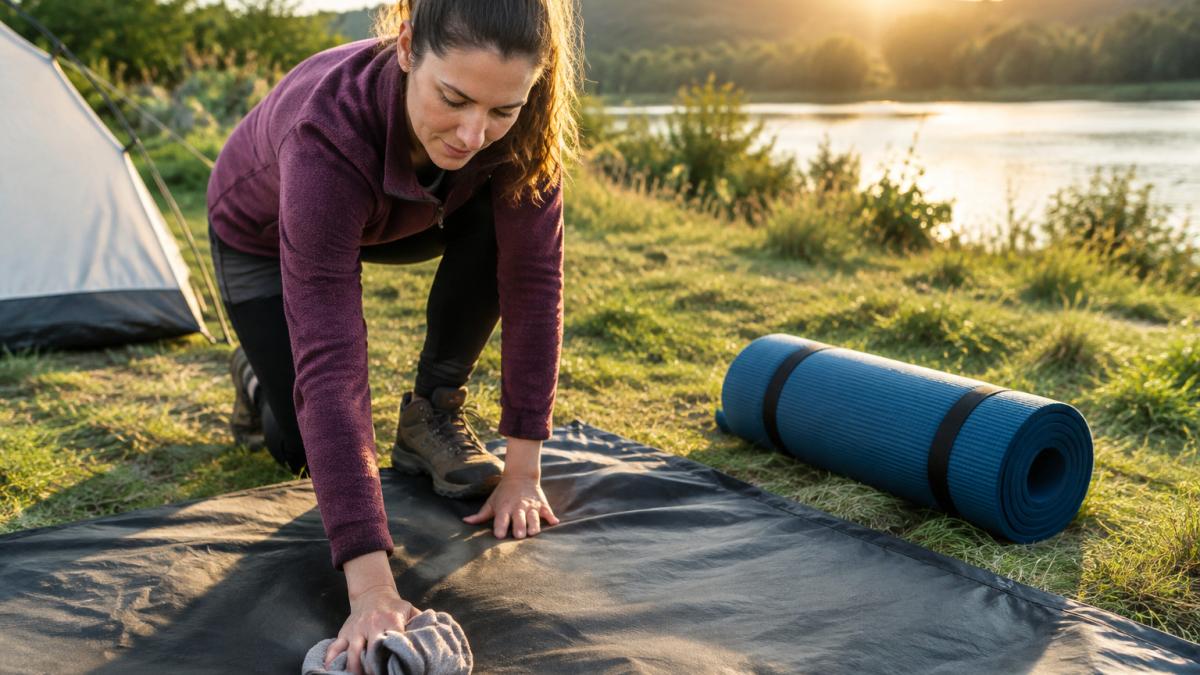
- Empty the tent completely. Remove bags, pillows and loose gear.
- Sweep out grit. Sand and small stones act like tiny ball bearings under a mat.
- Wipe the tent floor. Use a damp cloth, then dry the floor thoroughly.
- Wipe the mat. Clean its underside and the surface your bag rests on.
- Let everything dry. Damp gear slips more and can grow mould in a closed tent.
A common mistake is skipping the dry step. Even a little condensation can undo an hour of careful prep.
How to Stop a Sleeping Mat Sliding on a Tent Floor With Friction Fixes
Friction fixes add grip without changing how the mat works. Most campers start with one of these options and only move to a more permanent fix if they need it. The key is to match the fix to the surfaces you actually have, because a treatment that grips one tent floor can damage another.
Check Material Compatibility Before You Apply Anything
Tent floors and sleeping mats are made from a range of coated fabrics, and adhesives and silicone treatments can behave differently on each.
- Read the label against your gear. A product designed for silicone-coated fabrics may not bond to polyurethane, and vice versa. If the label does not name the material, treat it as unknown and test first.
- Test on a hidden patch. Apply a small amount to an inconspicuous area of the mat's underside or the tent floor, leave it for the full cure time, then check for softening, tackiness, discolouration or lifting of the coating.
- Watch the waterproof coating. Solvent-based adhesives can soften or strip polyurethane coatings. Water-based and silicone-based products are generally gentler, but still test.
A common pattern is to rush the cure and then blame the product when the mat sticks to itself in the stuff sack.
Anti-Slip Matting, Tape and Grip Strips
These are the simplest and most reversible options. They suit most people and cost little.
- Anti-slip matting: Cut a piece of rubber-backed matting slightly smaller than the mat, and place it under the sleeping mat.
- Friction tape: Apply strips in a grid across the underside of the mat. Keep the strips a few centimetres apart so the mat still folds easily. Avoid taping over seams or valves.
- Grip strips: Stick silicone or rubber grip strips to the mat's base. Test them on a quiet night before a long trip, and check that they do not peel at the edges when the mat is rolled.
Watch out: Heavy grip strips can make a lightweight pad bulkier to pack, and adhesive residue can attract grit that reduces grip over time. Weigh the extra material against the benefit before you commit.
Seam Sealer and Silicone: Permanent Options and Their Risks
Seam sealer and silicone create a tacky surface. They work well, but they are harder to undo and carry real risk to waterproof coatings.
- Apply thin, even coats to small areas first, using a small brush or your finger in a glove.
- Let each coat cure fully before you test it. Check the product's stated drying and cure time, and add extra time in cold weather.
- Confirm the product suits the material. Some adhesives can damage coatings, and some fabrics stiffen or discolour.
If you are unsure, start with tape or matting. You can always move to a permanent fix later.
Test the Fix Before You Rely on It
A fix that feels grippy in the garden can fail on a sloping pitch. Before a trip, set the mat up on a clean, dry floor, lie on it and wriggle for a minute, then check whether the mat or the bag has moved. Repeat after the mat has been packed and unpacked, because folding can lift tape edges and crack thick silicone.
Non-Slip Mat for Camping Sleeping Mat: Choosing a Solution Without Modifying Your Gear
Many campers do not want to alter their mat at all. That is a sensible choice, especially for a pad you plan to sell or use for years.
The easiest no-modification option is a separate non-slip layer. Place a rubber-backed mat or piece of carpet underneath your sleeping mat.
Compare the main options by what matters to you:
| Option | Effectiveness | Weight | Cost | Durability |
|---|---|---|---|---|
| Separate non-slip layer | Good | Adds some bulk | Low | High |
| Friction tape | Good | Very light | Low | Medium |
| Grip strips | Good | Light | Low to medium | Medium |
| Seam sealer or silicone | Very good | Very light | Low | High, but hard to remove |
For most weekend trips, a separate non-slip layer is the best balance of grip, convenience and reversibility.
Keeping Two Sleeping Mats Together in a Tent
Couples and friends often find that two mats drift apart overnight. The gap opens up the moment one person rolls over.
Try these approaches:
- Link the mats. Use a few strips of hook-and-loop tape or straps to hold the edges together.
- Add a grippy strip where they meet. A short length of non-slip matting along the join keeps both mats in line.
- Use a shared non-slip base. Place one large non-slip layer under both mats.
Linking the mats usually works best because it stops movement at the join, not just under each mat.
Tent Shape, Slope and Pitch Choices That Reduce Movement
Sometimes the tent is the problem. A pitch on a slope pulls everything downhill, no matter how grippy your mat is. But slope is only one part of the story: tent shape, floor geometry and how you lie on the mat all change the forces that push you sideways overnight.
Diagnose the Direction of Movement First
Before you change your pitch, work out which way the mat is travelling. Lie in the tent in your normal sleeping position and note whether the mat creeps towards the door, towards a side wall or downhill. If it moves consistently in one direction, the cause is likely slope or floor angle. If it moves in different directions on different nights, the cause is more likely the sleeper rolling or the bag dragging on the mat.
How Slope and Floor Angle Cause Nighttime Movement
A tent floor that is even a few degrees off level creates a constant downhill pull. On a gentle slope the mat may stay put while you are still, then slide as soon as you roll over and reduce the friction holding it. The steeper the angle, the less grip is needed to start movement. Sleeping position matters too: side sleepers concentrate weight on a narrow strip of mat, which can break the grip along that strip and let the rest of the mat pivot.
- Choose the flattest ground you can find. Avoid hollows where water collects, and check the ground with your hand as well as your eye.
- Pitch across a slope, not up and down it. This lowers the chance of rolling downhill and keeps the mat's long axis across the fall line.
- Level with stones or a groundsheet fold. Small adjustments under the footprint can reduce tilt, but keep them soft and flat so they do not create pressure points.
Test Your Setup Before You Commit to It
Pitch the tent, put the mat and bag in place, then lie down and roll from side to side for a minute. Note whether the mat stays put, creeps in one direction or pivots. If it moves, try rotating the mat 90 degrees, shifting it away from a seam, or adjusting the pitch before you add any grip product.
If the ground is uneven, a mat with a stronger grip becomes even more important, but grip alone will not fix a badly angled pitch.
Choosing Your Next Sleeping Mat: What to Look for in an Inflatable Pad
If your current mat keeps sliding no matter what you try, a different pad may be the answer. Look for features that suit your trips.
- Surface texture: A slightly textured or grippy top surface holds a sleeping bag better than a slick one.
- Built-in pump: Pumps save effort on arrival and are useful for quick setups.
- Thickness and insulation: Check the thickness and the R-value, which measures insulation from the ground.
Our current picks suit different needs. The Inflatable Camping Sleeping Mat with Built-In Pump at £32.95 folds quickly and includes a built-in air pump. The Camfy P3 Air Sleeping Pad at £49.99 offers 7.5cm of cushioning and an R-value of 2. The Inflatable Air Sleeping Pad Outdoor Mat at £15.95 weighs 490g and packs down small.


Before you buy any gear, check hiking gear quality before you buy to avoid expensive mistakes. If you want to know how a pad will hold up, test camping gear durability with these 7 field checks.
A sleeping mat should keep you warm, comfortable and in place all night.
Ready to upgrade your sleep setup? Browse TAKE A HIKE's full range of sleeping mats and find the pad that stays put all night.
Frequently Asked Questions
Why does my sleeping mat keep slipping in my tent?
Most sleeping mats slide because the nylon or polyester fabric is slick and the tent floor, often coated polyester or a groundsheet, offers little resistance. Movement is worse on a sloped pitch, when the tent floor is damp, or when the mat is not weighted by a sleeping bag or body. Check whether the mat or the bag is moving first, because the fix differs. Adding friction between the mat and the floor, or clearing the surfaces of dust and moisture, usually solves the problem without replacing any gear.
Will a non-slip mat stop a camping sleeping mat moving?
A separate anti-slip layer, such as rubber-backed matting or a cut-to-size grip sheet placed under the sleeping mat, can reduce sliding considerably. It works best when it is the same size as the mat and sits flat on the tent floor. Check that the layer does not trap moisture against the tent floor, and remember that it adds weight and bulk to your pack. For a no-modification option, a lightweight grip layer that can be removed before packing is usually the simplest choice.
Can I stop my sleeping bag sliding off my sleeping mat?
Yes. A sleeping bag tends to slide off a mat when both surfaces are slippery, particularly when you turn over in the night. Using a fitted sheet or liner that grips the mat, or choosing a mat with a textured top surface, reduces the movement. Strapping the bag to the mat with a short length of webbing can also help. Keep the bag dry, since damp fabric grips less.
How do I keep two sleeping mats together in a tent?
Connect the mats with mat connectors or loops designed for the purpose, or use a strap around both mats near the middle. Choose mats with similar edges and thickness so they sit level against each other. Pitch the tent on flat ground so neither mat rolls towards the low side, and keep a small gap closed with a sleeping bag or blanket for a firmer, more continuous sleeping surface.


