




Is Premium Hiking Survival Gear Worth Buying in 2026?
Last Updated: October 30, 2026
Quick Summary
Premium hiking survival equipment buys you reliability under failure, not extra features. The premium version earns its cost only when it saves grams or extends lifespan, so judge each item on weight-to-utility before it goes in your pack. Match your survival equipment to the scenario rather than packing for the worst case every time.
- A hiking survival kit earns its place through layers: shelter, warmth, light, water, navigation and first aid, each independent.
- The most common mistake is buying a large all-in-one kit and assuming it covers everything.
- A compact filter straw or squeeze filter handles stream and loch water for most UK wild camping.
- Premium spend is worth it on anything that keeps you warm, dry or visible; save on convenience items.
- Weigh your current big three on a kitchen scale, since the shelter is usually the heaviest item.
Table of Contents
- What Does Premium Hiking Survival Equipment Actually Buy You?
- Building a Hiking Survival Kit: What Earns Its Place in Your Pack
- Weight-to-Utility: The Ratio That Separates Premium Gear From Filler
- Choosing a Wild Camping Water Filter That Suits Your Trip
- Your Survival Gear Checklist for Hiking, Packed by Scenario
- Lightweight Camping Equipment: Where to Spend and Where to Save
- Maintenance and Shelf Life: Keeping Premium Gear Ready to Use
- Stock Your Pack With Field-Ready Kit
- Frequently Asked Questions
What Does Premium Hiking Survival Equipment Actually Buy You?
Premium hiking survival equipment buys you reliability under failure, not extra features.
Survival equipment is the set of tools and protective items a hiker carries to manage injury, exposure, darkness and loss of route, separate from comfort gear. The category earns its place only when each item solves a problem you cannot solve with what you already carry.
UK Met Office mountain weather guidance is worth reading before any purchase, because it shows how quickly conditions shift at altitude and why shelter and warmth outrank almost everything else.
Below, we break down what earns its place in a pack, where the weight-to-utility maths actually works, and how to keep premium kit usable for years rather than one season.
Building a Hiking Survival Kit: What Earns Its Place in Your Pack
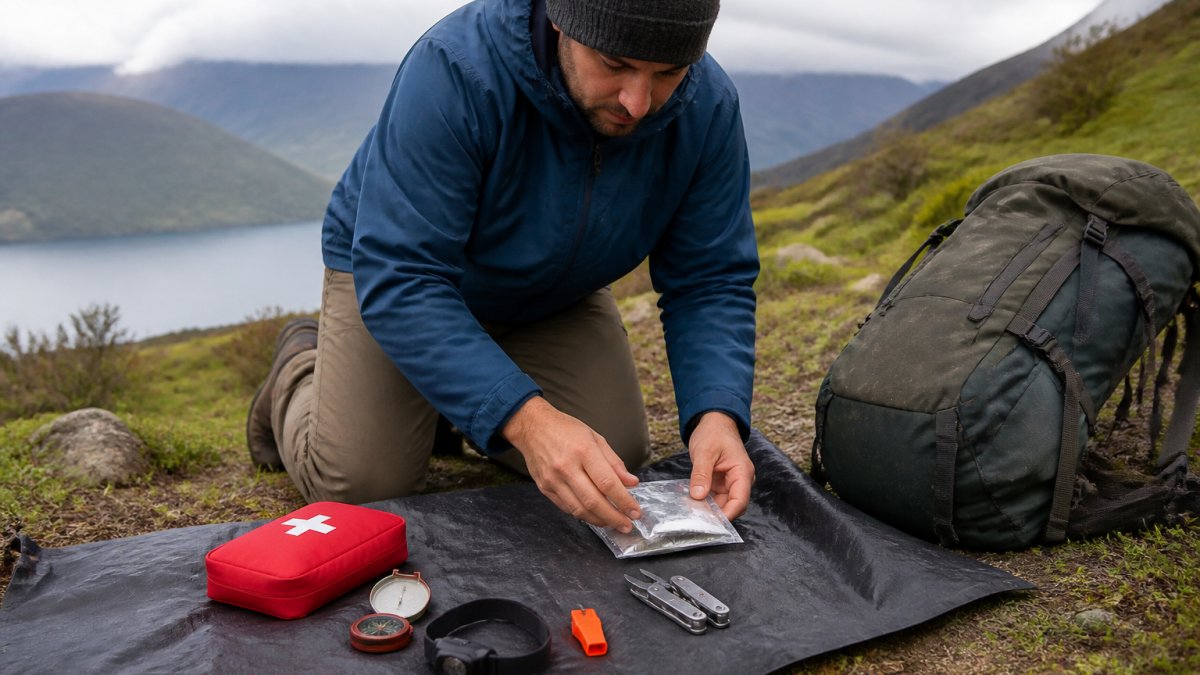
A hiking survival kit earns its place through the rule of layers: shelter, warmth, light, water, navigation and first aid, each independent of the others. If one item fails, another must still cover the same need. Most kits fail not because they lack items but because three items do the same job while a fourth need goes unmet.
The Core Layers: Shelter, Warmth and Light
An emergency bivvy or shelter bag, an emergency blanket and a headlamp with spare batteries form the non-negotiable base. Premium versions weigh less and pack smaller, which matters because the gear you resent carrying is the gear you leave behind. A headlamp beats a hand torch every time: it keeps both hands free for map work and first aid. Reliable cutting tools complete this essential kit, and investing in quality gear often distinguishes between a functional field repair and a failed expedition, as explored in this analysis of custom knives.
Tools, Navigation and Emergency Communication
A navigation compass, a paper map, a whistle and a multi-tool cover the next layer. Add a signalling mirror and a fire starter if your routes take you off marked paths. Emergency communication means telling someone your route and expected return time before you leave, plus a charged phone in a waterproof case.
Weight-to-Utility: The Ratio That Separates Premium Gear From Filler
Weight-to-utility is the measure of how much capability an item delivers per gram carried, and it is the single best filter for premium purchases. A 900g survival kit that covers first aid, shelter and fire has a far better ratio than 900g of duplicate tools.
Here is how we would judge any item before it goes in the pack:
- Name the specific failure it prevents.
- Confirm nothing else in the pack already covers that failure.
- Compare the weight against the alternative that does the same job.
- Check whether it survives being carried, dropped and repacked repeatedly.
- Decide whether the premium version earns its extra cost in grams saved or lifespan gained.
Watch out: the most common mistake is buying a large all-in-one kit and assuming it covers everything. Duplicated tools add weight, and the one missing layer, usually shelter or light, is the one that matters.
Choosing a Wild Camping Water Filter That Suits Your Trip
A wild camping water filter should match your water source, trip length and carrying capacity, not the other way round. For most UK wild camping, a compact filter straw or squeeze filter handles stream and loch water on the move, while a gravity system suits camp where you filter larger volumes at once.
UK Centre for Ecology & Hydrology water quality information is a useful starting point for understanding what varies in open water sources across the year.
Three practical checks before you buy:
- Flow rate and effort: a straw you drink through directly suits quick top-ups; a gravity bag suits camp.
- Weight and packed size: the 18cm Portable Drinking Water Filter Straw weighs roughly 105-300g and slips into a side pocket, which is why it suits fast and light trips.
- Backup: carry purification tablets as a second method, because a blocked filter has no field fix.
If you want the full decision process, our guide on how to choose a water filter for wild camping walks through source types, flow rates and trip length. When you are ready to buy, the portable drinking water filter straw covers the lightweight end of the range.
125-Piece Survival & First Aid Kit →
Your Survival Gear Checklist for Hiking, Packed by Scenario
A survival gear checklist for hiking should be built around scenarios, not a single master list. Day hikes, wild camps and winter routes need different kits, and packing for the worst case every time means carrying weight you never use. Match the kit to the trip, then keep one core layer constant across all of them.
| Scenario | Core kit | Added items | Leave behind |
|---|---|---|---|
| Day hike, low level | First aid, headlamp, whistle, water filter | Emergency blanket, compass | Bivvy, fire starter |
| Wild camp, one night | Full core plus shelter | Bivvy, fire starter, extra food | Heavy pump filter |
| Multi-day trek | Full core plus repair kit | Signalling mirror, spare batteries | Duplicate tools |
| Winter or high ground | Full core plus insulation | Extra layers, emergency shelter | Lightweight summer bag |
Start with the core and add only what the scenario demands, keeping the pack light and every item justified.
Lightweight Camping Equipment: Where to Spend and Where to Save
Lightweight camping equipment is worth premium spend in three places: anything that keeps you warm, dry or visible. Save on anything that only adds convenience. A cheap stove that works is fine; a cheap shelter that fails is a night in the cold.
Set a weight budget before you shop, so every item you add has to earn its grams.
Here is where the grams actually come off, and where premium spend earns its keep:
| Category | Typical budget weight | Typical premium weight | Where the saving comes from |
|---|---|---|---|
| Two-person shelter | 2.5-3.5kg | 1.0-1.8kg | Silicone-coated fabrics, aluminium rather than fibreglass poles |
| Sleeping mat | 800g-1.2kg | 350-550g | Closed-cell foam replaced by air construction with laminated insulation |
| Sleeping bag or quilt | 1.2-1.8kg | 600-900g | Higher fill-power down and tighter baffle design |
| Headlamp | 120-200g with AA cells | 50-90g with integrated battery | Regulated output and lithium power |
| Cook set | 500-800g | 250-400g | Titanium or hard-anodised aluminium |
For a wider view of gram-saving choices, our lightweight camping gear guide sets out where the weight actually comes off without losing capability.
Maintenance and Shelf Life: Keeping Premium Gear Ready to Use
Consumables have shelf lives, and a kit that sat untouched for two seasons is not a kit you can rely on. Check it before every trip and replace anything past its date.
Three mechanisms do most of the damage:
- Moisture and humidity attack sterile packaging, corrode batteries and encourage mould in fabric. A kit stored in a damp shed or a cold garage will age faster than one kept in a dry cupboard indoors.
- Heat and UV break down rubber seals, elastic and plastic. A rucksack left in a hot car through summer can perish hydration-bladder seals and headlamp gaskets in a single season.
- Chemical ageing affects adhesives, purification tablets and fire-lighters regardless of storage. These have a fixed shelf life from the date of manufacture, not from first use.
| Item | Typical shelf life | Replace when |
|---|---|---|
| Sterile dressings and bandages | 3-5 years from manufacture | Packaging is damaged, or the expiry date passes |
| Adhesive plasters and tape | 2-3 years | Adhesive no longer sticks cleanly |
| Purification tablets | 2-3 years unopened; often 1 year once opened | Date passes or tablets discolour |
| Fire lighters and matches | 2-5 years depending on type | Wrapper is compromised or striker is worn |
| Headlamp batteries (alkaline) | 5-7 years stored; far less in use | Leakage, corrosion or dim output |
| Emergency blanket | Indefinite if undamaged | Any tear, or coating flakes when unfolded |
| Water filter | No fixed expiry; performance degrades with use | Flow drops noticeably or the cartridge reaches its rated volume |
A simple quarterly routine keeps a pack field-ready:
- Test the headlamp and replace batteries
- Check sterile dressings and adhesive items for expiry dates
- Inspect the emergency blanket for tears and repack it
- Run clean water through the filter and check the flow
- Confirm the whistle, compass and mirror are present and undamaged
- Check shelter seams and waterproof coatings
- Restock any first aid item used since the last check
Storage matters as much as inspection. Keep the kit indoors, dry and out of direct sunlight, and store it in a sealed pouch rather than loose in a rucksack pocket where it collects grit and moisture. If you are unsure whether a piece of kit is still sound, our guide on how to check hiking gear quality covers the inspection points that reveal wear before it becomes failure.
Stock Your Pack With Field-Ready Kit
TAKE A HIKE stocks survival and first aid kits, including the 125-Piece Survival & First Aid Kit at £82.95, the 47-Piece Survival Kit in Oxford Pouch at £63.95 and the Multifunctional Outdoor Survival First Aid SOS Kit at £35.95. Orders over £50 ship free with tracked UK delivery, unused items are covered by our 14-day return policy, and our customer support is available six days a week, 8am to 8pm UK time.


Get started with TAKE A HIKE and build a pack you can carry with confidence on every route this season.
Frequently Asked Questions
What should be in a hiking survival kit?
A workable hiking survival kit covers five jobs: shelter, warmth, water, light and first aid. In practice that means shelter, warmth, water, light and first aid items suited to the trip. Weigh everything and cut duplicates. A 47-piece kit in a 600D Oxford pouch weighs around 900 g, so a compact kit plus one or two trip-specific extras is usually enough for a day hike.
How do I choose a reliable wild camping water filter?
Start with the water source and the trip length. A filter straw suits fast-and-light trips where you drink straight from a stream and space is tight; an 18 cm straw weighs roughly 105-300 g and packs into a side pocket. For multi-day trips or filling bottles and cooking pots, a pump or gravity filter saves time and effort. Check the filter suits the water you will meet, keep it from freezing, and back it up with purification tablets in case it clogs.
Are premium hiking survival kits worth buying?
They are worth it when the gear has to work first time, in bad weather, away from help. If you hike regularly, the cost per trip falls quickly. If you go out twice a year on marked trails, a mid-range kit covers most needs. Match the spend to how far you go from a road, and check the return policy before buying.
What is the difference between a survival kit and a first-aid kit?
A first-aid kit treats injuries: bandages, gauze, tape, scissors, tweezers and a tourniquet. A survival kit keeps you alive and functional until help arrives or you reach safety: shelter, warmth, water purification, fire starting, light, navigation and signalling. Many kits combine both. A 125-piece option, for example, pairs 25 survival tools with a 100-piece first aid kit in one carry case. Carry the combined kit if weight allows, and know how to use every item before you need it.


