



9 Best Hiking Shoes for Rocky Trails in 2026
Quick Summary
The best hiking shoes for rocky trails have a grippy outsole that bites into angular stone, a firm midsole, a protective toe box and a heel that stays locked in place. For wet, mixed ground, the ROCKROOSTER Newland Grey 4 Inch Waterproof model is a strong overall pick at £49.95.
- Choose an outsole that bites into angular surfaces rather than skating across them.
- A firm midsole stops your foot feeling every stone on uneven ground.
- The ROCKROOSTER Newland Grey 4 Inch offers a Hydro-guard waterproof, breathable membrane.
- Boots suit heavy packs and loose ground, while waterproof shoes suit shorter days on established paths.
- Check heel lock on a slope and leave about a thumb's width of toe clearance.
Table of Contents
- Why Rocky Trails Demand a Different Kind of Shoe
- How We Evaluated These Hiking Shoes
- Best Overall Hiking Shoes for Rocky Trails
- Best Hiking Shoes for Scrambling and Technical Terrain
- Hiking Boots vs Hiking Shoes: Which Suits Rocky Ground
- Best Trail Running Shoes for Hiking Rocky Routes
- Fit, Care and Choosing Your Pair for Rocky Trails
- Frequently Asked Questions
Why Rocky Trails Demand a Different Kind of Shoe
Last Updated: November 7, 2026
Rocky trails punish footwear in ways a smooth path never will. Sharp edges cut through soft uppers, loose stones shift underfoot, and wet granite can be as slippery as ice. Choosing the best hiking shoes for rocky trails means looking past general comfort and asking how a shoe handles grip, protection and fit on uneven ground. Matching your next pair to the terrain you actually walk is what counts.
Several things set rocky ground apart. The outsole has to bite into angular surfaces rather than skate across them. The midsole needs enough firmness to stop your foot feeling every stone. The toe box and upper need to shrug off knocks from rock edges. And the heel needs to hold steady, because a loose heel on a steep, stony slope is where ankles get hurt.
Waterproofing is a separate question. Many British fells are wet for much of the year, and a membrane keeps moisture out, though it can also trap heat in warmer months. Think about your typical conditions before deciding whether a waterproof shoe or a breathable one is the better fit.
How We Evaluated These Hiking Shoes
The shoes featured here come from the TAKE A HIKE range. Each is described using the specification and listing details available for it, including construction, fitting width and intended use.
Use the notes on sizing and the features each listing names to narrow your choice.
Best Overall Hiking Shoes for Rocky Trails
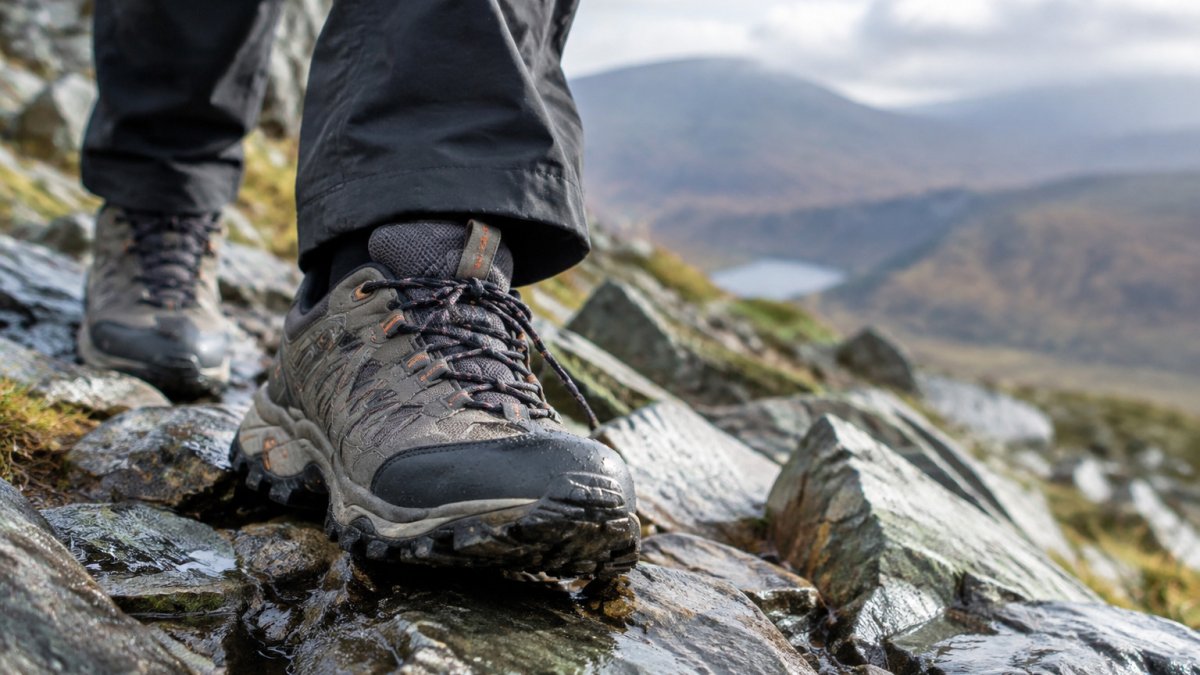
The ROCKROOSTER Newland Grey 4 Inch Waterproof Hiking Shoes KS5514 suit mixed ground. This low-cut leather shoe has a Hydro-guard waterproof, breathable membrane and a rubber outsole based on Goodyear tyre tread, built to grip wet rock and mud. The CoolMax lining and anti-fatigue insole with Poron are features of the shoe, and the wide E fitting gives your toes room.

Pros:
- Waterproof membrane that still breathes
- Slip-resistant, Goodyear-pattern outsole
- Roomy E-width toe box
- Priced at £49.95
Cons:
- Sizing is US-based, so check the size chart carefully
- A low cut gives less ankle support than a boot
If you want more ankle coverage on the same terrain, the ROCKROOSTER Walland Black 6 inch Waterproof boot (£89.99) offers a similar membrane and slip-resistant sole in a six-inch build, with a soft toe and wide fitting. That extra ankle coverage can help on rough ground, while RockResist socks add another layer of protection against abrasion inside the boot.
The table below compares the three shoes featured in this section, using the details given above.
| Shoe | Price | Key feature |
|---|---|---|
| ROCKROOSTER Newland Grey 4 Inch | £49.95 | Hydro-guard waterproof membrane, Goodyear-pattern outsole |
| ROCKROOSTER Walland Black 6 inch | £89.99 | Six-inch build, slip-resistant sole, wide fitting |
| Military Tactical Hiking Shoes | £39.95 | Deep-lug non-slip sole, low and high-cut options |
Price
Best Hiking Shoes for Scrambling and Technical Terrain
The Military Tactical Hiking Shoes (£39.95) have a non-slip sole with deep lugs, a padded collar and tongue, and tough uppers. They are offered in low and high-cut versions.
Pros:
- Deep-lug non-slip sole for stability on rock and mud
- Tough, scrape-resistant uppers
- Low and high-cut options
Cons:
- Water resistant rather than fully waterproof
- Sized in EU; a UK 8 is roughly an EU 42
Best for: scrambling and rough woodland on dry or damp ground. Skip if: your routes are regularly wet, since the ROCKROOSTER Newland has a proper membrane.
Match the shoe to the rock, not just the route
Rocky terrain is not one condition, and the shoe that feels secure on a dry gritstone edge can feel vague on wet limestone. It helps to think about the surface you walk on:
- Wet slabs and smooth rock. Polished limestone and wet granite reward a soft, sticky rubber compound and a high ratio of edge contact over deep lugs. A hard, blocky lug pattern skates here; a shallower, softer sole bites. If your routes include wet slabby sections, prioritise rubber softness and a rounded heel edge for braking.
- Loose scree and talus. Angular, shifting stone punishes a soft midsole and a shallow lug. You want a deeper lug pattern that can wedge between stones, a firmer midsole to stop the foot rolling, and a higher-cut collar or boot to keep grit out. The Walland's six-inch build offers more ankle coverage than a low shoe.
- Roots and mixed woodland rock. Roots are slippery when wet and uneven underfoot, so a sole with a mixed lug pattern, deep at the heel, shallower at the toe, transitions better than a uniform block. A rock plate or firmer midsole helps here because roots concentrate pressure into a small area.
- Hard-packed rock and established paths. Long sections of firm rock favour a flatter, more durable lug and a shoe that does not over-cushion, since too much soft foam makes the foot feel vague on edge. This is the terrain where a lighter shoe or trail runner makes most sense.
If you cannot try before you buy, read the outsole description against the surface you walk most, not against the most dramatic terrain you occasionally meet.
Watch out: a deep-lug sole that grips well on scree can feel skittish on wet, smooth rock, so do not assume more lug depth is always better.
Hiking Boots vs Hiking Shoes: Which Suits Rocky Ground
Boots generally give more ankle support, while shoes are lighter. The right choice depends on your load, your ankles and how steep and loose your routes tend to be.
If you carry a heavy pack over broken, unstable ground, a boot such as the ROCKROOSTER Walland gives more ankle support. For shorter days on established rocky paths, a waterproof shoe like the ROCKROOSTER Newland usually feels better. The Women's Waterproof Hiking Shoes with Non-Slip PU Soles (£34.95) are another lighter option for women walking on rough ground.
Best Trail Running Shoes for Hiking Rocky Routes
Trail runners are lighter and faster to dry than hiking shoes, which appeals to fast-moving walkers. Browse our trail running shoes for UK terrain to see which models suit rocky routes. The trade-off is less protection and support under load. The Quick-Dry Non-Slip Outdoor Hiking Shoes with Mesh Upper (£25.95) have a breathable mesh upper, a non-slip rubber outsole and an EVA midsole. Note that its mesh upper is not waterproof, so it is best kept for drier days.
The Outdoor Hiking Shoes (£19.95) have a grippy outsole and a reinforced toe cap.
Fit, Care and Choosing Your Pair for Rocky Trails
A good fit matters on rocky ground, because descents push your toes forward and a loose heel can affect stability. The following checks can help you spot common problems before you commit to a long walk.
Fit for technical descents
- Heel lock. Your heel should sit back in the heel cup with no lift when you stand on a slope. Try the shoe on a ramp or a stair edge: if the heel rises more than a few millimetres, the shoe is either too long or the lacing is not holding the midfoot.
- Toe clearance. Leave roughly a thumb's width between your longest toe and the front of the shoe when standing. On steep rocky descents your foot slides forward, and too little clearance is the usual cause of toe bang and lost toenails.
- Lacing for descents. Use a heel-lock or runner's loop through the top eyelets to pull the heel back into the cup. On long descents, tighten the upper lacing and leave the lower lacing slightly looser so the forefoot can spread without the heel lifting.
- Width and volume. A wide E fitting such as the ROCKROOSTER Newland gives toes room to spread on descents, but too much volume lets the foot slide. If the shoe feels roomy but your heel lifts, a thicker sock or a volume-reducing insole is often better than sizing down.
- Sock choice. A thin liner plus a cushioned walking sock reduces friction, which is what causes blisters on long rocky descents. Avoid cotton, which holds moisture against the skin.
Care and wear checks
Clean off grit after muddy walks, let shoes dry away from direct heat, and treat leather uppers occasionally. Check the outsole regularly: once the lugs have worn smooth at the heel and forefoot, grip on wet rock falls off quickly, and that wear pattern is the clearest sign the shoe is due for replacement. Also check the midsole for compression creases and a flattened feel under the ball of the foot; a packed-out midsole loses the underfoot protection that rocky ground demands, even when the tread still looks serviceable.
Choosing between shoes, boots and trail runners
Use pack weight, ankle preference and route difficulty as the deciding framework:
- Heavy pack over loose, unstable ground: a boot such as the ROCKROOSTER Walland gives more ankle support and protection.
- Shorter days on established rocky paths: a waterproof shoe like the ROCKROOSTER Newland usually feels better and is lighter on the feet.
- Fast, light walking on dry, well-maintained rocky ground: a trail runner or the Quick-Dry Non-Slip Outdoor Hiking Shoes (£25.95) suit the style, accepting less protection under load.
- Women walking rough ground: the Women's Waterproof Hiking Shoes with Non-Slip PU Soles (£34.95) are a lighter option.
Wear new shoes around the house for a few evenings before a long walk, and take them on a short rocky route before committing to a full day. Ready to kit out your next rocky route? Browse the full TAKE A HIKE footwear range and compare the options above against your terrain. You can also read our full guide to choosing hiking boots if you are still deciding between boots and shoes.
Frequently Asked Questions
What hiking shoes are best for rocky trails?
For rocky trails, look for a shoe with a deep, multi-directional lug pattern, a firm midsole and a rubber sole that grips wet stone. Among the options from TAKE A HIKE, the ROCKROOSTER Walland (£89.99) is a six-inch boot with a waterproof membrane, while the ROCKROOSTER Newland (£49.95) is a lower-cut option with a Goodyear-pattern rubber outsole.
Are hiking boots or hiking shoes better for rocky trails?
Hiking boots give more ankle support and protection on uneven, loose rock, which helps on heavy packs and long descents. Hiking shoes are lighter and more flexible, so they suit well-maintained rocky paths and faster walking. If your route involves carrying weight over rough ground, a boot such as the ROCKROOSTER Walland is the safer choice. For day walks on mostly firm rock, a lighter shoe is usually more comfortable.
Do I need waterproof hiking shoes for rocky trails?
Not always, but wet rock is slippery and British trails are often damp. A waterproof membrane keeps your feet dry on boggy approaches, which also reduces blisters. The ROCKROOSTER Newland and Walland both use Hydro-guard waterproof membranes. The Military Tactical Hiking Shoes are water resistant rather than fully waterproof, so they suit drier days better.


