



How to Choose Hiking Boots: A Complete 2026 Guide
Table of Contents
- Start With the Terrain: Matching Footwear to Trail Conditions
- Hiking Boots vs Hiking Shoes: Which One Do You Actually Need?
- Ankle Support, Boot Height, Sole Stiffness and Underfoot Protection
- How Should Hiking Boots Fit: A Step-by-Step Fitting Guide
- Leather vs Synthetic Materials, Waterproofing and Breathability
- B1 vs B2 Boots: Understanding Boot Ratings and What They Mean
- How to Break In Hiking Boots and Prevent Blisters
- Making the Final Choice: A Quick Decision Framework
- Frequently Asked Questions
Last Updated: October 5, 2026
Start With the Terrain: Matching Footwear to Trail Conditions
Choose hiking boots by terrain, not looks: ground conditions decide grip, height, stiffness and weight.
This guide from TAKE A HIKE walks you through that decision. Get it right and your feet stay comfortable for years; get it wrong and every walk ends in blisters.
Think of it as three rough categories, not dozens of products.
Lowland Paths, Woodland Tracks and Canal Towpaths
Flat, firm ground needs little from a boot. A low-cut hiking shoe with a flexible sole handles towpaths, parkland and gentle woodland tracks.
Weight matters more than support here. Lighter footwear means less fatigue on longer days.
Muddy Trails, Slippery Paths and Rocky Ground
Here grip and underfoot protection earn their place. Look for a deep, aggressive outsole tread that bites into mud and holds on wet rock.
Sharp stones are the other problem, a stiffer sole spreads the pressure so you do not feel every rock.
Long-Distance Trekking and Multi-Day Backpacking
A loaded pack changes the maths: extra weight demands more support, a stiffer platform and a higher ankle cut.
- Day hiking: light and flexible is fine
- Weekend trips with a pack: mid-height, medium stiffness
- Multi-day backpacking: higher cut, stiffer sole, more protection
Hiking Boots vs Hiking Shoes: Which One Do You Actually Need?
Hiking boots give ankle support and underfoot protection for rough, heavy or multi-day use. Hiking shoes are lighter and cooler for firm, gentle trails.

The honest answer: buy the lightest footwear that still handles your worst day out.
Boots win when you carry weight, walk rocky ground or want ankle support on tired legs; shoes win for speed, breathability and less bulk in your bag.
When Trail-Running Shoes Make Sense
Trail-running shoes suit fast, light day walks on firm, well-drained paths: cool, quick-drying and very light.
Where they fall short is protection. Thin soles and soft uppers struggle on sharp stones, deep mud and long days with a pack.
Ankle Support, Boot Height, Sole Stiffness and Underfoot Protection
Ankle support comes from boot height and how well the upper locks your heel down, not stiffness alone.
Boot height runs from low-cut shoes to mid boots to full boots. Higher cuts add stability on rough ground and protect the ankle.
Sole stiffness is separate: a stiffer sole protects against sharp stones and supports a heavy pack, while a flexible sole feels more natural on easy ground.
- Traction and grip: deep lugs for mud, softer rubber for wet rock
- Stability: a firm heel counter that holds the foot in place
- Underfoot protection: a shank or stiff midsole against sharp stones
Our ROCKROOSTER Walland is a waterproof boot that shows how these pieces fit together: a soft toe for lighter weight, a wide E fitting, and a slip-resistant rubber sole.

How Should Hiking Boots Fit: A Step-by-Step Fitting Guide
Hiking boots should fit snug at the heel, roomy at the toes and locked at the midfoot, with a thumb's width in front of your longest toe. If your heel lifts when you walk, the boot is wrong.
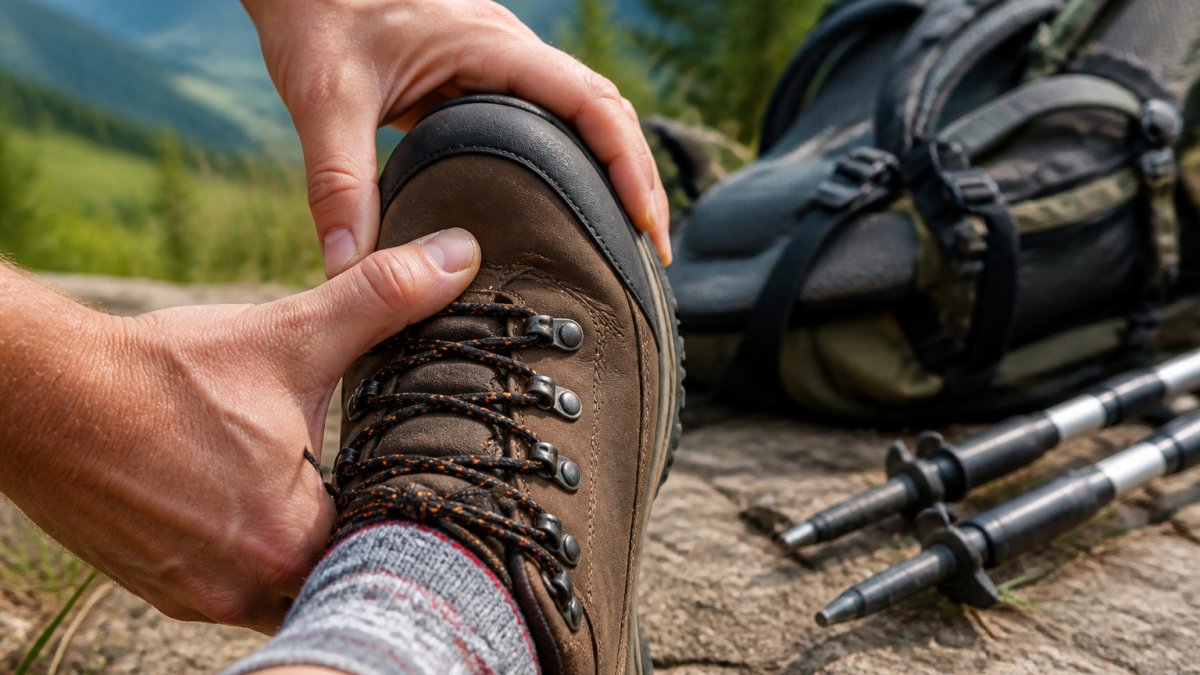
Follow this order every time you try a pair:
- Wear the walking socks you will actually hike in
- Stand up and press the toe box, checking for a thumb's width of room
- Walk downhill on a ramp or step and watch for heel lift
- Check the midfoot: snug, but not pinching across the top
- Try the other foot too, feet are rarely identical
- Walk around for ten minutes before deciding
Toe Room, Heel Hold and Trying Boots With Walking Socks
Toe room stops toes jamming on descents; heel hold stops the friction that causes blisters.
Socks change fit more than most people expect: a thin liner and a thick walking sock can shift you half a size.
Sizing varies by brand and system. Our ROCKROOSTER Newland runs in US men's sizes, so check the chart before ordering: a UK men's 8 is about a US men's 9, and women should add 1.5 to their US women's size.

Leather vs Synthetic Materials, Waterproofing and Breathability
Leather lasts longer and moulds to your foot, but is heavier and slower to dry. Synthetics are lighter, dry faster and need less care. Neither is better; they suit different walks.
How Leather and Synthetic Uppers Behave Differently
Full-grain leather is the most durable upper: it resists abrasion from rock and scree, moulds to your foot over weeks, and can be reconditioned and repaired.
Nubuck and split leather sit between full-grain and synthetic: lighter and softer, but they wear faster on abrasive ground.
How Waterproof Membranes Actually Work
A waterproof membrane is a thin layer laminated inside the boot, with pores small enough to block liquid water but large enough to let sweat vapour escape, so it can be both waterproof and breathable.
The catch is that breathability drops sharply as the outside temperature falls and humidity inside the boot rises, so in cold, wet conditions a membrane boot can feel clammy.
Waterproofing Treatments and Re-Proofing
Even a membrane boot relies on a durable water repellent (DWR) finish on the outer fabric or leather.
ROCKROOSTER Walland Black 6 inch Waterproof Tactical Outdoor Hiking →
Re-proofing is straightforward: clean the boot, let it dry, then apply a spray or wax suited to the upper material, leather takes wax or conditioner, synthetic and mesh take a spray-on DWR.
Matching Materials to Conditions
| Material | Best For | Watch Out For |
|---|---|---|
| Full-grain leather | Wet, muddy, long-term use; rocky ground | Heavier, slower to dry, needs conditioning |
| Nubuck / split leather | General hillwalking, mixed conditions | Wears faster than full-grain |
| Synthetic / mesh | Warm weather, fast drying, light loads | Less abrasion resistance, less support |
| Waterproof membrane | Rain and wet ground | Traps sweat if breathability is poor |
| Non-waterproof, fast-draining | Warm wet conditions, stream crossings | Feet get wet, but dry quickly |
A Practical Drying and Care Routine
After a wet walk, rinse mud off with cool water, stuff the boots with newspaper or a drying insert, and leave them at room temperature away from direct heat.
For leather boots, apply conditioner every few months and a wax or waterproofing treatment at the start of the season. For synthetic boots, a spray-on DWR is usually enough.
Our ROCKROOSTER Newland pairs a leather upper with a waterproof, breathable membrane and a Goodyear-pattern rubber outsole that grips wet rock and mud, a sensible pick for wet, muddy paths. For warm, dry summer walks, breathable mesh shoes like our Quick-Dry Non-Slip Outdoor Hiking Shoes keep feet cooler, with an EVA midsole for light cushioning and a non-slip rubber outsole.
B1 vs B2 Boots: Understanding Boot Ratings and What They Mean
Boot ratings describe how stiff a boot's sole is and what ground and activity it suits. The B1/B2/B3 system is widely used across European walking and mountaineering footwear, and understanding it stops you buying too much boot or too little.
What Actually Determines a Boot Rating
Three things drive the rating:
- The shank: a stiffening plate (often nylon, fibreglass or steel) built into the midsole. A full-length shank makes the boot rigid; a three-quarter or half shank leaves the forefoot flexible.
- The midsole density: firmer EVA or polyurethane resists compression and holds its shape under load.
- The upper construction: a stiffer, higher-cut upper with a firm heel counter and a rand around the toe adds torsional rigidity.
A boot's rating is a rough summary of how those elements combine, not a single measurable number.
B1: Flexible, Lowland and Hill Walking
B1 boots flex at the forefoot and feel close to a sturdy walking shoe. They suit:
- Lowland paths, woodland tracks and canal towpaths
- Rolling hills and well-trodden national trails
- Day walks with a light pack
A B1 boot will not take a crampon safely: the sole flexes too much for the crampon to stay seated, so they are not rated for winter mountaineering.
B2: Semi-Rigid, Mountain and Winter Use
B2 boots have a stiffer sole that flexes only at the very front, giving you:
- Edge support on rocky ground and scree
- A platform that takes a semi-automatic crampon (one with a rear heel clip and a front strap)
- Better load transfer when carrying a heavier pack on steep terrain
Most UK hillwalkers who venture onto winter ground or rocky ridges settle on a B2, though it feels clumpy on easy towpaths and takes longer to break in.
B3: Fully Rigid, Mountaineering
B3 boots are almost completely rigid, take a fully automatic crampon (front and rear clips) and are designed for steep snow, ice and mixed ground. On a lowland path they feel like ski boots, so they are a specialist tool rather than an all-rounder.
Matching the Rating to Your Hardest Day
The common mistake is buying for the average walk rather than the hardest one: if your hardest day involves winter conditions or a rocky ridge, a B2 is the sensible floor; if it is a muddy towpath in February, a B1 is plenty.
How Ratings Interact With Fit and Break-In
A stiffer boot takes longer to mould to your foot: B2 and B3 boots often need several short walks before they feel comfortable, and a poor fit in a stiff boot is far more punishing than in a flexible one. Try a stiff boot with the socks and insoles you intend to use, and check the heel stays locked when you flex the sole.
How to Break In Hiking Boots and Prevent Blisters
Break boots in gradually before any long day out: start with 20 to 30 minutes around the house, then short local walks, then build up. Leather takes longer than synthetic.
Blisters come from friction, moisture and heat. Fix all three:
- Wear proper walking socks, not cotton
- Keep feet dry with breathable footwear where you can
- Stop and adjust laces the moment you feel a hot spot
Care, Maintenance and Repair for Long-Term Durability
Clean mud off after every walk and let boots dry at room temperature, never on a radiator.
Treat leather occasionally to keep it supple and water-resistant, and replace laces before they snap mid-walk.
Our Women's Waterproof Hiking Shoes are a low-cost option for lighter walks, with a waterproof design and a traction sole for rough ground.
Making the Final Choice: A Quick Decision Framework
Use this shortcut when you are staring at two pairs and cannot decide:
- Firm, flat paths, day walks: low-cut hiking shoes
- Muddy or rocky trails: waterproof shoe with a deep-lug outsole
- Multi-day trips with a pack: boot with a stiffer sole
Still unsure? Buy from a shop with a clear returns policy and try them indoors first. TAKE A HIKE offers a 14-day money-back promise on unused items, free tracked delivery on orders over £50, and customer support six days a week, 8am to 8pm.
Frequently Asked Questions
Should hiking boots be too big or too small?
They should be neither. Aim for about a thumb's width of space between your longest toe and the front of the boot. Too small causes blisters and black toenails on descents; too big lets your foot slide, which also causes blisters and reduces stability. Try boots with the socks you'll wear on the trail, and if you're between sizes, size up rather than down.
What is the difference between B1 and B2 hiking boots?
B1 boots have a flexible sole and are designed for low-level walks, woodland tracks and gentle trails. B2 boots have a stiffer midsole and a more supportive upper, suited to rougher ground, rocky paths and multi-day backpacking. B3 boots are fully rigid and reserved for winter mountaineering. Most UK day hikers and weekend campers are best served by B1 or B2.
How do you break in new hiking boots?
Wear them indoors for a few evenings, then take short walks on pavement before hitting trails. Gradually increase distance and load over one to two weeks. Leather boots may need longer than synthetic ones. Always wear the walking socks you plan to use, keep toenails trimmed, and stop at the first sign of a hot spot rather than pushing through.
Are hiking boots or hiking shoes better for walking?
Hiking shoes are lighter and cooler for gentle paths and day hikes, while boots offer ankle support, underfoot protection and better grip on rough or muddy terrain. If you carry a heavy pack or walk on sharp stones and slippery paths, boots are the safer choice. For lowland walks and canal towpaths, shoes often feel more comfortable.
Choosing hiking boots is a trade-off between weight, support and protection, and only you know which one your walks demand. Get the fit right and everything else falls into place.
At TAKE A HIKE, we stock boots and shoes for every kind of walk, from lowland paths to multi-day treks. Every pair comes with free tracked delivery on orders over £50 and a 14-day money-back promise on unused items.
Get started with TAKE A HIKE and find the footwear that fits your trail.


