



Are Tactical Hiking Shoes Good for Walking?
Last Updated: November 5, 2026
Quick Summary
Tactical hiking shoes are good for walking on rough, varied terrain such as mud, bracken and rough tracks, thanks to their grippy soles and protective uppers. For long, flat or all-day wet walks, a conventional hiking shoe or waterproof boot is usually the better choice.
- Their grippy outsoles and padded collars suit rough tracks, wet woodland and bushcraft trips.
- Firmer soles protect the foot on uneven ground but can feel clumsy over long distances.
- Military Tactical Hiking Shoes are available in both low and high-cut versions.
- Tactical hiking shoes are water resistant rather than fully waterproof, so they suit dry or damp conditions best.
- Test fit late in the day with your walking socks and check toe room on a downward slope.
Table of Contents
- What Tactical Hiking Shoes Are and Who They Are For
- Tactical Boots vs Hiking Boots: Where the Real Differences Lie
- Tactical Shoes vs Hiking Shoes for Everyday Walking
- Comfort, Flex and Support on Pavements, Trails and Longer Walks
- Tactical Boots for Walking: Protection, Weight and Breathability
- How to Test Fit and Comfort Before You Commit
- Choosing the Right Pair From the TAKE A HIKE Range
- Frequently Asked Questions
What Tactical Hiking Shoes Are and Who They Are For
Tactical hiking shoes are military-style footwear built for rough ground, combining a grippy outsole with padded support and a tough upper. Yes, they can be good for walking, but only for the right kind of walk.
The term covers a broad group of shoes. Some sit low on the ankle, while others rise to a higher cut for extra support. Our Military Tactical Hiking Shoes come in both low and high-cut versions.

They suit people who walk on mixed terrain: rough tracks, wet woodland, bracken, and weekend bushcraft trips. They also suit anyone who wants one pair for the camping box and the allotment as well as the hills. They are less suited to all-day walking in persistent wet, where a shoe with a true waterproof membrane performs better.
Tactical Boots vs Hiking Boots: Where the Real Differences Lie
Tactical boots and hiking boots overlap, but they are built around different priorities. Tactical footwear puts durability, protection and grip first. Hiking footwear puts comfort, flex and weight first. Understanding that difference explains most of the trade-offs you will feel on a long walk.
Tactical boots tend to have stiffer soles and heavier construction. That stiffness protects the foot on uneven ground and when carrying load, but it can feel clumsy over distance.
The ROCKROOSTER Walland shows how the categories blur. It is a six-inch boot with a Hydro-guard waterproof membrane, a water-resistant suede upper, a Poron insole and a slip-resistant rubber sole. Its soft toe keeps it light, and its wide fitting gives toes room on descents.
Tactical Shoes vs Hiking Shoes for Everyday Walking
For everyday walking, a tactical shoe works well if your route is varied and your priority is grip and stability. If you want to compare against a conventional option, see our guide to men's hiking shoes. A dedicated hiking shoe usually wins if you walk long distances on well-maintained paths and want the lightest possible feel.
Here is how the two compare for everyday use:
| Factor | Tactical Hiking Shoes | Conventional Hiking Shoes |
|---|---|---|
| Ground suited | Rough tracks, mud, bracken | Trails and mixed paths |
| Sole stiffness | Firmer, more protective | Flexes with natural gait |
| Weight | Heavier | Lighter |
| Water resistance | Often water resistant only | Often membrane-equipped |
| Best for | Varied terrain, camping, bushcraft | Long-distance and day walks |
Tactical shoes can be a sensible choice for the walk to the shops, the dog walk and the weekend camp. For a daily commute on pavements, a lighter shoe with more cushioning is usually more comfortable. We recommend deciding which of these everyday uses matters most before buying.
Comfort, Flex and Support on Pavements, Trails and Longer Walks
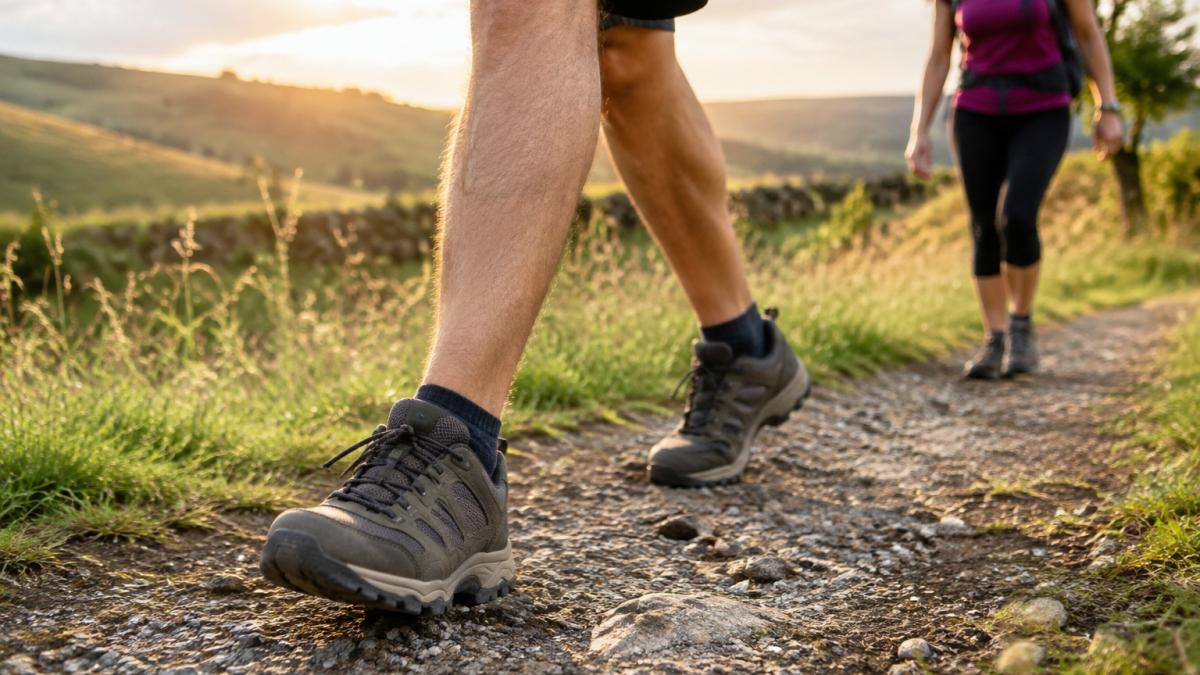
Comfort is not a single property of a shoe; it is the match between the shoe's construction and the surface, distance and load you walk with. A tactical hiking shoe that feels secure on gravel can feel jarring on tarmac, and a flexible trail shoe that feels natural on a woodland path can feel vague on loose stone. The useful question is not whether tactical shoes are comfortable in the abstract, but how their sole stiffness, cushioning and upper support behave on each surface you actually walk.
Walking on Pavement and Urban Surfaces
Pavement is the hardest common walking surface, and it exposes the main weakness of tactical hiking shoes. Their outsoles are built for grip and protection rather than shock absorption, so a firm midsole transmits impact through the foot and up the leg with every step.
The outsole pattern also matters on pavement. Deep, blocky lugs that bite into mud can feel slightly unstable on smooth, wet tarmac because less rubber is in contact with the ground. A flatter, more closely spaced tread gives better contact on hard surfaces.
A practical compromise for mixed urban and rough-ground use is a tactical shoe with a moderately deep lug pattern and a cushioned insole.
Trails, Gravel and Rough Ground
On trails, gravel and rough ground the trade-off reverses. A firmer sole spreads pressure from sharp stones and roots, and a padded collar and tongue hold the foot steady when the ground is uneven. This is where tactical hiking shoes perform closest to their design intent.
A common pattern is that walkers notice the benefit of a stiffer sole most on descents and side slopes, where a flexible shoe lets the foot roll and the ankle work harder. For longer walks where flex and cushioning matter more, browse our comfortable walking boots. If your routes include uneven ground, a tactical shoe's stability is a genuine comfort feature, not just a durability one.
Trade-offs by Walking Duration and Distance
Short walks of an hour or two suit almost any well-fitted shoe, and the differences between tactical and conventional hiking shoes are minor. As distance increases, the balance shifts. Stiffer soles can cause fatigue in the arch and calf, especially when carrying a pack, because the foot cannot flex naturally through each step. Heavier uppers add to leg fatigue over many miles.
Military Tactical Hiking Shoes →
As a general guide, tactical hiking shoes suit shorter to medium walks on varied terrain and heavier loads over rough ground. For long, flat, multi-hour walks on maintained paths, a lighter shoe with better flex and cushioning usually serves you better.
Tactical Boots for Walking: Protection, Weight and Breathability
Protection is the main reason people choose tactical boots, and it is a real benefit on uneven or hazardous ground. A firm upper and toe protection guard against knocks, and a well-built sole reduces the risk of twisting an ankle on loose rock.
Weight and breathability are the trade-offs. Heavier boots tire the legs over distance, and leather or synthetic uppers can trap heat and moisture. If keeping water out matters most, explore our waterproof walking boots.
Breathability matters most in warm weather or during sustained effort. If you sweat heavily, look for a lining designed to wick moisture, and consider a lighter shoe for summer use. For cold, wet conditions, membrane-equipped boots help keep feet dry.
How to Test Fit and Comfort Before You Commit
Fit is where most walking shoes succeed or fail, and tactical hiking shoes are no exception. Because their uppers are often stiffer and their soles firmer than conventional hiking shoes, a poor fit is less forgiving and more likely to cause rubbing, pressure points or toe bruising. The good news is that you can test most of this before you commit, using a repeatable checklist rather than a quick try-on.
A Repeatable Fit Checklist
Test shoes later in the day when your feet are at their largest, and wear the socks you will actually walk in. Then work through these checks:
- Toe room: Stand and press your thumb across the top of the toe box. You want roughly a thumb's width of space beyond your longest toe. On a gentle downward slope, your toes should not touch the front of the shoe.
- Heel hold: Walk a few steps and check that your heel stays seated. Excessive heel slip causes blisters; a locked-in heel with no pressure on the Achilles is the target.
- Width and pressure points: Feel across the top of the foot and around the ball. There should be no tightness over the instep and no pinching at the widest part of the foot. A wide fitting helps if you have broad feet or wear thicker socks.
- Arch comfort: Stand for several minutes. You should feel support, not a hard ridge under the arch. If the insole feels intrusive, the shoe may be the wrong shape for your foot.
- Ankle collar: With a low-cut shoe, check the collar does not dig into the ankle bone. With a higher cut, check the cuff does not rub the shin or Achilles.
Testing on a Slope and Under Load
A flat shop floor hides most fit problems. If you can, walk up and down a slope or a step. On the descent, your foot will slide forward; if your toes hit the front, the shoe is too short or the lacing is too loose. On the ascent, check your heel does not lift excessively.
If you plan to carry a pack, wear it or a similar weight during the test. Load changes how your foot sits in the shoe and how much pressure you feel under the arch and across the forefoot. A shoe that feels fine unladen can feel tight under a loaded pack.
Break-In and Sizing Notes
Stiff tactical boots and shoes often need a few short wears before a long walk. Wear them around the house and on short walks first, and watch for hot spots. Persistent pain is a signal to change size or style, not to push through.
Sizing varies by range. Our Military Tactical Hiking Shoes use EU sizing, so a UK 8 is roughly an EU 42. The ROCKROOSTER boots use US men's sizing, where a UK men's 8 is roughly a US 9. Check the size chart on each product page before ordering, and go down half a size if your feet are narrow.
Choosing the Right Pair From the TAKE A HIKE Range
Match the shoe to the job. If you need grip and protection on rough, varied ground, our Military Tactical Hiking Shoes are a strong choice, and you can pick a low or high cut to suit your ankle needs.
For all-day wet ground, the ROCKROOSTER Newland and Walland have proper waterproof membranes. The Newland is a low-cut leather shoe at £49.95 with a Goodyear-pattern outsole.
For budget-conscious walkers, the Quick-Dry Non-Slip Outdoor Hiking Shoes at £25.95 offer a breathable mesh upper and a lightweight EVA midsole for varied terrain.
So, are tactical hiking shoes good for walking? For varied, rough terrain and camp-to-trail use, yes. For long, flat, urban or all-day wet walks, a conventional hiking shoe or waterproof boot is usually the better fit.
Frequently Asked Questions
Are tactical hiking shoes comfortable for long walks?
For shorter walks on reasonably even ground, most people find tactical hiking shoes comfortable enough. Padded collars and tongues help, and the non-slip soles give confidence on mud and wet grass. Over longer distances, the stiffer soles and heavier builds of many tactical designs can cause foot fatigue, so a lighter hiking shoe with a flexible midsole is usually the better choice for full days on the trail. A good test is a 5 to 6 km loop in the shop or at home before committing to a longer walk.
Can you wear tactical boots for everyday walking?
Yes, tactical boots work for everyday walking, particularly if you need ankle support or wear them for work. The trade-off is weight and stiffness: a heavier boot with a rigid sole can tire your feet and calves over a long day on pavements. If you mainly walk on pavements, a lighter tactical shoe such as the Military Tactical Hiking Shoes from TAKE A HIKE, at £39.95, is often more comfortable than a full boot.
Are tactical shoes better than hiking shoes?
Neither is better in every situation. Tactical shoes tend to be tougher, with deeper lugs and robust uppers that handle scrapes and rough use well. Hiking shoes are usually lighter and more flexible, which suits long walks and natural foot movement. For mixed use, such as woodland walks, camping and town walking, a tactical hiking shoe offers a sensible middle ground. Choose according to your main terrain and how far you typically walk.
Do tactical hiking shoes need breaking in?
Most tactical hiking shoes need a short break-in period, especially if the upper is stiff or the collar is firm. Wear them around the house for a few evenings and then take short walks before using them on a longer route. Leather designs such as the ROCKROOSTER Newland, at £49.95, often soften with use, while synthetic uppers may feel stiff at first but settle within a few outings.


