



Best Camping Tent for Beginners UK: 2026 Picks
Table of Contents
- Quick Comparison: Best Camping Tents for Beginners
- Best Overall: 4 Season Camping Tent
- Best Value: Automatic Easy Outdoor Tent
- Best Family Tents: Camping Tent Double Layer
- Best Wild Camping Tents: Ultralight Camping Pyramid Tent
- Easy-to-Pitch Camping Tents: Setup Time Compared
- Camping Tent Buying Guide for Beginners
- What Getting Started Actually Costs
- Frequently Asked Questions
Last Updated: October 16, 2026
Quick Comparison: Best Camping Tents for Beginners
The best camping tent for beginners in the UK is one you can pitch alone, in wind, without a manual. That rules out a surprising number of cheap tents. Below, we compare our own picks by price, capacity, packed weight and best use, so you can match a tent to your trip rather than to a photo.
| Tent | Price | Best For | Packed Weight | Setup |
|---|---|---|---|---|
| Automatic Easy Outdoor Tent | £24.95 | Budget first trips | Not stated | Automatic |
| Waterproof Camping Tent | £45.95 | Wet-weather camping | Not stated | Quick assembly |
| 4 Season Camping Tent | £89.95 | Two-person, three-season | 2.65 kg | Standard poles |
| Camping Tent Double Layer | £99.95 | Families and groups | Not stated | Straightforward |
| Ultralight Camping Pyramid Tent | £87.95 | Solo backpacking | Light and compact | 2 minutes |
| Ultralight Camping Tent | £149.95 | Multi-day walking | Low weight | Fast, simple |
A beginner-friendly tent is one that pitches in minutes, keeps rain out and has enough headroom to sit up. Everything else is a bonus.

Best Overall: 4 Season Camping Tent
Our top pick for a first serious tent is the 4 Season Camping Tent at £89.95. The spec tells the story: a 5,000 mm flysheet, a 7,000 mm groundsheet and aluminium alloy poles.
It sleeps two, with a 200 × 140 cm inner and 100 cm of height. At 2.65 kg packed, it splits easily between two rucksacks.
The trade-off is colour: supplied as mixed violet, green or wine red, and we cannot guarantee a specific one.
Best Value: Automatic Easy Outdoor Tent
Budget does not have to mean miserable. The Automatic Easy Outdoor Tent costs £24.95 and pitches automatically, which removes the single biggest source of first-trip stress. It is designed for family camping trips, weekend getaways and outdoor holidays, and comes in six colours.

Where it falls short: the listing gives no dimensions, materials or weather rating. Check it suits your group and expected conditions before you commit. For a dry-forecast weekend, it is hard to argue with the price.
Best Family Tents: Camping Tent Double Layer
Space changes everything for families. The Camping Tent Double Layer at £99.95 has two separate bedrooms, so parents and children get their own sleeping areas. The double-layer design adds protection and insulation, and the waterproof construction keeps the interior dry in changeable weather.
It is available in orange or blue. Allow enough pitch space for the large two-bedroom layout, and check your storage before buying, as packed dimensions are not listed.
Best Wild Camping Tents: Ultralight Camping Pyramid Tent
Wild camping rewards light kit and fast pitching. The Ultralight Camping Pyramid Tent at £87.95 pitches with one pole and four pegs in about two minutes. A pyramid sheds wind well because there is nothing to thread.

The 160 cm peak gives sit-up room, and it packs small for solo backpackers and bikepackers. The catch: pyramids need a solid pitch. Use every guy point, and pick ground your pegs will actually hold. A trekking pole can replace the centre pole.
If you carry more kit or want a tougher fabric, the Ultralight Camping Tent at £149.95 is a backpacking option, built with waterproof fabrics and ventilation to manage condensation.
Easy-to-Pitch Camping Tents: Setup Time Compared
Setup time is the number beginners care about most, and it is rarely printed on the box. The honest answer is that setup time depends less on the tent type than on whether you have pitched that specific tent before.
Here is how the main types compare for a genuine first attempt, assuming one person and no prior practice.
| Tent type | Realistic first-time setup | Practised setup | Main difficulty for beginners |
|---|---|---|---|
| Automatic / pop-up | 2-5 minutes | Under 2 minutes | Folding it back into the bag |
| Pyramid (single pole) | 5-10 minutes | 2-3 minutes | Finding ground pegs will hold |
| Dome | 10-20 minutes | 5-8 minutes | Working out which pole goes where |
| Tunnel | 15-25 minutes | 8-12 minutes | Pitching into the wind |
Automatic and pop-up tents. These unfold and lock into shape with little assembly. The catch is packing them down: most beginners find the collapse-and-fold step harder than the pitching step, and a tent that will not go back in its bag is a real problem on a wet morning.
Pyramid tents. One central pole, four corner pegs, then tension the guys. There is nothing to thread, which removes the most common beginner error. The trade-off is that a pyramid depends entirely on its pegs, so it is a poor choice on hardstanding or loose ground.
Dome tents. The classic beginner tent. You thread or clip two or three poles, attach the inner, then throw over the flysheet. The difficulty is identifying which pole is which, especially in low light. Colour-coded poles solve this, and most mid-range domes now use them.
Tunnel tents. These offer the best space-to-weight ratio and suit families, but they are the least forgiving in wind. You must pitch them end-on into the wind and peg them out in the right order, or the whole thing acts like a sail.
Pole systems explained. Fibreglass poles are cheap and flexible but heavier and prone to splintering. Aluminium alloy poles are lighter, stiffer and more durable, which is why our top pick uses them. If a pole sleeve feels tight, do not force it; a little silicone spray on the pole joints makes threading easier.
A realistic pitching sequence for any tent:
- Clear the ground of stones and twigs, and lay out the footprint or groundsheet.
- Assemble the poles and lay them along their sleeves or clips before threading.
- Peg the corners loosely first, then tension once the structure is up.
- Fit the flysheet and check it does not touch the inner, or condensation will soak through.
- Peg out every guy line, even on a calm day, because UK weather changes fast.
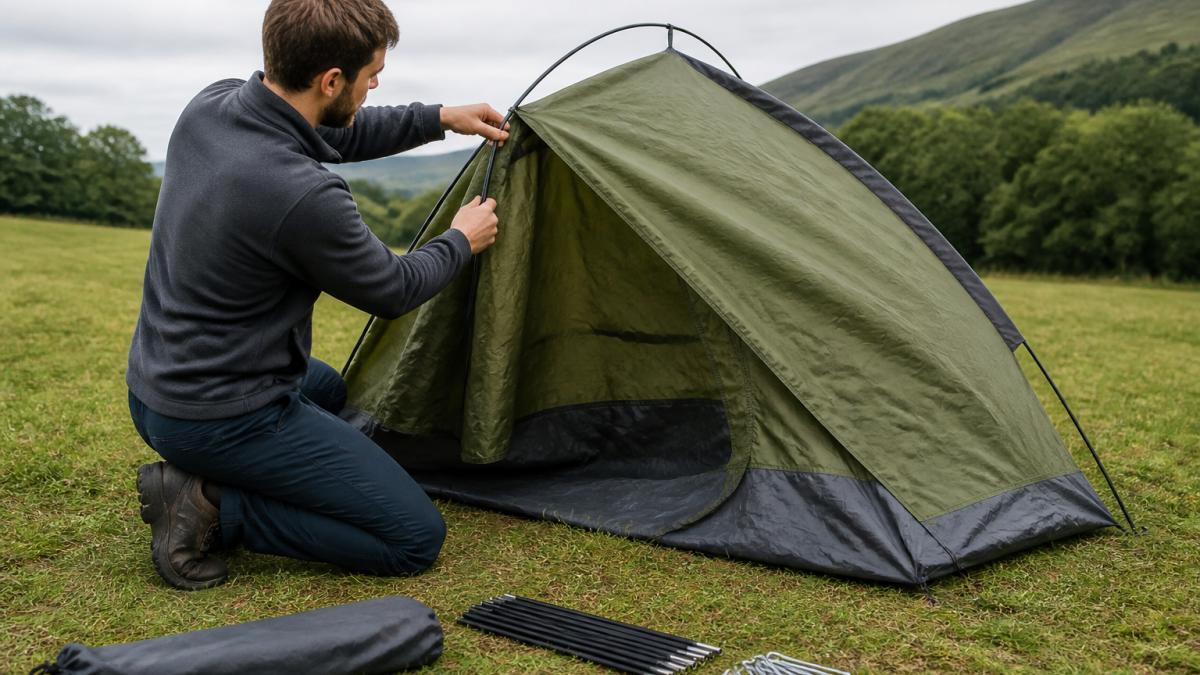
If you are buying your first tent, favour an automatic or dome design with colour-coded poles, and avoid tunnel tents until you have a few pitches behind you.
Camping Tent Buying Guide for Beginners
Most buying guides list the same five factors and leave you no closer to a decision. This one translates the numbers on a tent spec into what they mean for a typical UK trip.
Start with where you will camp, not with the tent. The single biggest beginner error is buying a tent for the trip they imagine rather than the trip they will take.
Campsite tents can be heavier, larger and cheaper, because you are not carrying them far. Prioritise living space, headroom and a porch for wet gear.
Backpacking tents must be light and pack small, which usually means a smaller inner and less headroom. You pay a premium for every gram saved.
Wild camping tents sit between the two: light enough to carry, but tough enough to handle exposed ground and wind.
Capacity in real-world use. A "two-person" tent is comfortable for two sleepers with minimal kit. Add two rucksacks, walking boots and a stove, and it feels tight.
Weather protection, translated. The hydrostatic head rating tells you how much water pressure a fabric resists before it leaks. As a rough guide for UK conditions:
- 1,500 mm and below: fine for a dry summer weekend, not for sustained rain.
- 2,000-3,000 mm: adequate for three-season campsite use.
- 5,000 mm and above: genuinely weatherproof for British wind and rain.
Check the rating on both the flysheet and the groundsheet, because a strong flysheet over a weak groundsheet still means a wet sleeping bag. Look for taped or sealed seams, and a flysheet that reaches low to the ground to shed driving rain.
Season ratings, explained for novices. A three-season tent covers spring, summer and autumn, which is what most UK campers actually need.
Ventilation and condensation. Condensation, not rain, can soak beginners. Mesh panels, vents and a flysheet that does not touch the inner all help moist air escape.
Weight and pack size. Only matters if you carry the tent. If you drive to the campsite, prioritise space over grams. If you walk, weigh the whole package, including pegs and poles, not just the quoted figure.
Pitching. Freestanding designs are easier on hard ground. Check the pole system, how many pegs you need, and whether the tent can be pitched outer-first, which keeps the inner dry in rain.
Durability. Look at the denier (fabric thickness) and the pole material. Aluminium alloy poles outlast fibreglass.
For official guidance on camping safely and responsibly, see the UK government countryside access guidance.
What Getting Started Actually Costs
Getting started costs more than the tent alone, and beginners are usually surprised by the extras. Budget for the tent first, then the kit that makes the trip work.
- Tent: from £24.95 for a budget automatic model to £149.95 for a backpacking tent
- Sleeping bag and mat: essential for warmth and comfort
- Lighting: a head torch beats a phone light every time
- Groundsheet or footprint: protects the base and adds insulation
- Pegs and guy lines: upgrade the thin ones that come in the bag
At TAKE A HIKE, we stock tents, lighting and survival equipment so you can kit out in one order. Free tracked delivery applies on orders over £50, and our 14-day return policy covers unused items. Customer support runs 6 days a week, 8am to 8pm.
For safety and access rules where you plan to camp, check the official guidance on wild camping and access rights.
Frequently Asked Questions
What should a beginner look for when buying a camping tent?
Start with capacity and packed weight. A tent sold as two-person fits two people with little room for kit, so size up if you want space. Check the packed weight if you will carry the camping tent any distance, and look for a hydrostatic head of at least 2,000 mm on the flysheet for wet weather. Ventilation and a solid groundsheet matter more than colour or brand. Pitch it at home once before your first trip.
How many people should a beginner tent sleep?
Buy for one more person than will sleep in it. A couple should look at a three-person shelter, and a family of four at a five or six-person model. Tent capacity counts sleeping bodies, not bags and boots, and the porch area is where that kit lives. If you want separate sleeping space, a two-bedroom design such as the Camping Tent Double Layer keeps adults and children apart without needing two tents.
Is a pop-up tent suitable for a first camping trip?
It can be, if you accept the trade-offs. Pop-up and automatic designs pitch in seconds, but they are bulky to carry and awkward to fold away in wind. An automatic tent like the Automatic Easy Outdoor Tent at £24.95 suits car camping weekends where weight does not matter. If you plan to walk to your pitch, a pole-based tent packs smaller and handles stronger wind better.
How do you choose a tent that is easy to pitch?
Fewer poles and fewer sleeves mean less time on your knees. A single-pole pyramid design, such as the Ultralight Camping Pyramid Tent, goes up in about two minutes because there is nothing to thread. Dome tents with colour-coded fibreglass poles are the next simplest. Avoid anything with more than three pole sections for a first tent, and always practise the pitch in daylight before you arrive at the campsite.
How much does it cost to start camping?
A usable beginner setup starts with the tent. The Automatic Easy Outdoor Tent is £24.95, the Waterproof Camping Tent is £45.95 and the 4 Season Camping Tent is £89.95. Add a sleeping bag, mat and stove, and a realistic first-season budget sits between £150 and £300. Delivery is free on orders over £50, and there is a 14-day money-back promise on unused items if a tent turns out to be the wrong size.
The hardest part of buying a first tent is knowing which spec actually matters. We built TAKE A HIKE to remove that guesswork, with tents chosen for real conditions and a 14-day return policy on unused items. Browse our range, take advantage of free tracked delivery on orders over £50, and get equipped for your first night under canvas.


